The best fence for a Lexington-area home depends first on what the fence must do. Choose wood when you want full privacy, natural character and custom styling. Choose vinyl when you want solid privacy with less routine finish maintenance. Choose aluminum when visibility, an open appearance and low maintenance matter more than screening the yard. Post layout, gates, grade and drainage will affect long-term performance regardless of material.
Central Kentucky yards are rarely identical. One property may be level and open; another may have a slope, mature tree roots, tight side access or a pool barrier requirement. Start with the job the fence must perform, then compare complete systems instead of selecting a material from one sample panel.
Originally published September 23, 2026; substantially reviewed and updated September 30, 2026 by Yellowstone Renovation.
Quick comparison: wood, vinyl and aluminum
| Decision factor | Wood | Vinyl | Aluminum |
|---|---|---|---|
| Full backyard privacy | Excellent with solid boards | Excellent with privacy panels | Usually poor; most styles are open |
| Routine finish care | Highest of the three | Low; cleaning may be needed | Low; inspect coating and hardware |
| Custom sizing and trim | Very flexible | Limited to compatible system parts | Many styles, but system-dependent |
| Sloped yards | Boards can follow grade or step | Must use approved racking or stepping | Rackable sections may follow grade |
| Individual repairs | Boards and rails can often be replaced | A damaged section may require system parts | Rails or sections use matched components |
| Natural appearance | Strongest | Consistent manufactured finish | Open, ornamental appearance |
| Pool-area potential | Possible only when the complete design complies | Possible with a compliant system | Common choice, but spacing and gate details must comply |
No material is automatically “pool safe,” “pet proof” or maintenance-free. Those results depend on fence height, opening sizes, bottom gaps, gate hardware and the rules that apply to the specific property.
Wood fencing: best for custom privacy and a natural look
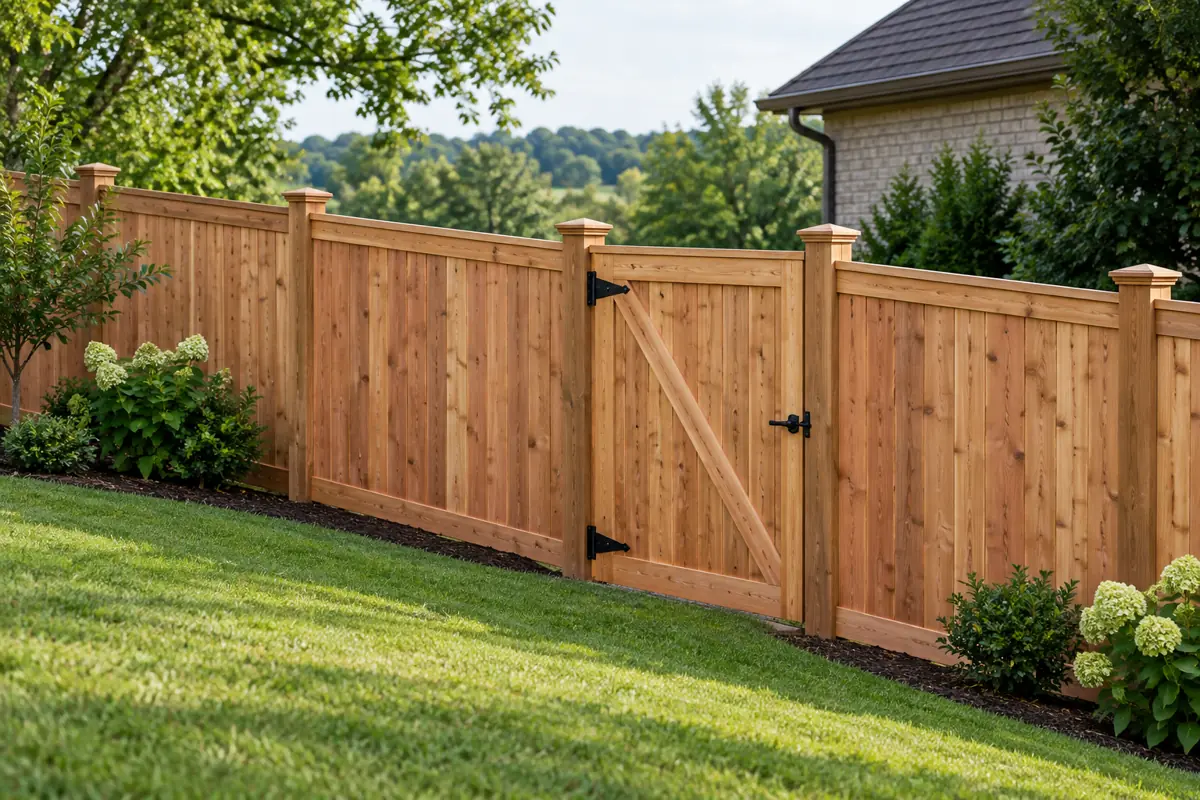
Wood remains a practical choice for privacy yards because an installer can work board by board. It can be built side-by-side, board-on-board, horizontal, dog-ear, cap-and-trim or with other details that fit the home. Boards can often be adjusted to follow uneven ground while keeping the bottom gap under control.
The tradeoff is exposure. Sun, rain and soil moisture affect wood over time. Posts and other components used in or near the ground need lumber treated for the intended exposure. The American Wood Protection Association distinguishes above-ground and ground-contact use categories; a stamp or supplier description should match where the piece will be installed. Cut ends and drilled areas also need treatment when the product instructions require it.
Wood is usually the strongest fit when you want:
- a solid privacy enclosure;
- custom gates, heights or trim where permitted;
- a natural material that can be stained;
- board-by-board adjustment on an irregular grade; or
- repairability without replacing an entire manufactured panel.
Maintenance expectations should be clear before signing. A new pressure-treated fence may need time to dry before finishing. Cleaning, stain or sealer, loose-board repairs and gate adjustments may be needed over its service life. Review the AWPA's homeowner guidance for treated wood when comparing lumber specifications.
Vinyl fencing: full privacy with a consistent finish
Vinyl privacy fencing is attractive to homeowners who want a solid enclosure without a recurring staining schedule. The surface does not rot like wood, and routine care is generally washing rather than refinishing. It creates a uniform appearance that works well around patios and newer subdivisions.
Vinyl is a system, not a collection of interchangeable boards. Posts, rails, panels, stiffeners, caps and gate hardware need to be compatible. Posts must be placed accurately, and expansion, wind exposure and grade transitions should follow the manufacturer's installation instructions. Damage can be more complicated to repair if the original profile or color is no longer available.
Vinyl is a strong candidate when you prioritize:
- solid privacy with low finish maintenance;
- a consistent color and panel layout;
- no stain or paint cycle; and
- a clean enclosure around a patio or backyard.
Ask the proposal to identify the manufacturer and product line, not just “white vinyl fence.” Review the manufacturer's installation instructions and warranty exclusions, including limitations related to improper installation, impact, ground movement or external heat. Barrette Outdoor Living, for example, publishes separate vinyl fence installation instructions and warranty documents for its systems.
Aluminum fencing: best for visibility and open boundaries
Aluminum is fundamentally different from a solid privacy fence. Its spaced pickets preserve sightlines, which can make a front yard, landscaped area or pool enclosure feel less closed in. Factory-applied finishes reduce routine surface work, and rackable sections may follow moderate slopes without the stair-step appearance of rigid privacy panels.
The open design is also its limitation. Standard aluminum fencing does not screen neighbors, equipment or street views. Small pets may require closer picket spacing or an approved puppy-picket section. Gates must use the correct hinges, latches and posts for their width and purpose.
Aluminum is usually the best fit when you want:
- an open view through the fence;
- ornamental styling without the upkeep of painted steel or wood;
- a boundary around landscaping or a front yard; or
- a pool-barrier option designed and installed to the applicable requirements.
For pools, do not select a product by appearance alone. The U.S. Consumer Product Safety Commission recommends a barrier that completely surrounds the pool and discusses self-closing, self-latching gates in its residential pool barrier guidance. Local code and the approved product details control the actual project.
Which material works best for common Lexington-area goals?
Privacy from close neighbors
Wood and vinyl are the direct choices. Wood offers more custom detailing and a warmer look; vinyl reduces finish maintenance and stays visually consistent. Aluminum will define the boundary but usually will not solve the privacy problem.
A sloped backyard
Wood can be stepped or adjusted board by board. Vinyl may need stepped sections or a manufacturer-approved racking range. Many aluminum sections are designed to rack, but the allowable angle varies. Have the contractor show how the bottom gap and top line will look before installation.
Dogs and children
Focus on gaps, gate latches and dig-prone areas rather than material alone. A solid fence can reduce visual stimulation for some dogs, while an open aluminum fence preserves supervision. Confirm picket spacing and the gap below every section; do not assume a standard panel contains every pet.
A pool enclosure
Start with barrier requirements, not color. Height, openings, climbability, gate swing, self-closing action and latch placement can all matter. Wood, vinyl or aluminum may be usable only when the complete assembly meets the applicable rules.
A custom gate or wide equipment access
Wood provides substantial design flexibility, but every wide gate needs adequate posts and hardware. Vinyl and aluminum gates should use compatible reinforced components. Measure the mower, trash cart, trailer or equipment that must pass through before setting post locations.
The site plan can matter more than the panel material
Before pricing, mark the intended fence line and identify corners, gates, utilities, grade changes, roots, drainage paths and existing concrete. Property-line questions should be resolved before holes are dug. HOA approval and local zoning or permit questions also belong at the beginning of the job.
Lexington homeowners can use the city's building-permit and homeowner resources to confirm which department should review a particular scope. Yellowstone Renovation does not assume that one rule applies to every municipality or HOA in Central Kentucky.
For a deeper layout walkthrough, read our privacy-fence gate and slope guide.
How to compare fence estimates
Each proposal should state:
- measured linear footage and fence height;
- exact material, style and product line;
- post size, spacing and intended treatment or coating;
- rail, panel or board configuration;
- gate quantity, clear opening, frame and hardware;
- slope treatment and expected bottom gaps;
- removal and disposal of the existing fence and concrete; and
- exclusions for rock, roots, concealed utilities or property-line work.
That scope is more useful than choosing the lowest single number. A quote missing gates, demolition or grade details is not directly comparable to a complete proposal.
Yellowstone Renovation's wood-cap fence project in Nicholasville and vertical wood fence project in Frankfort show verified completed wood-fence styles. Browse the broader Project Showcase for additional exterior work. Homeowners near our base can also review the Nicholasville service-area page.
Frequently asked questions
Is wood, vinyl or aluminum the cheapest fence?
There is no reliable answer without a measured scope. Height, total footage, gates, demolition, grade, access, product line and post system can change the installed price. Compare complete proposals rather than generic national per-foot figures.
Which fence requires the least maintenance?
Vinyl and aluminum generally need less routine finish work than wood. Both still need cleaning and inspection, and gates or damaged components may need adjustment or replacement.
Which fence is best on a slope?
Wood offers the most custom board-by-board adjustment. Rackable aluminum can follow many grades cleanly. Vinyl depends on the system's approved racking range or a planned stepped layout.
Can aluminum provide backyard privacy?
Standard ornamental aluminum fencing is open and is not intended to provide full privacy. If screening is the main goal, compare solid wood or vinyl systems.
Plan a fence around how your yard is actually used
Sketch the fence route, note the gates you need and request an on-site estimate. Yellowstone Renovation can measure the route, review gates and grade, and compare wood, vinyl and aluminum based on the actual yard rather than a generic material ranking.